What Would You Say? Practice Real-Life English with Chat Reply
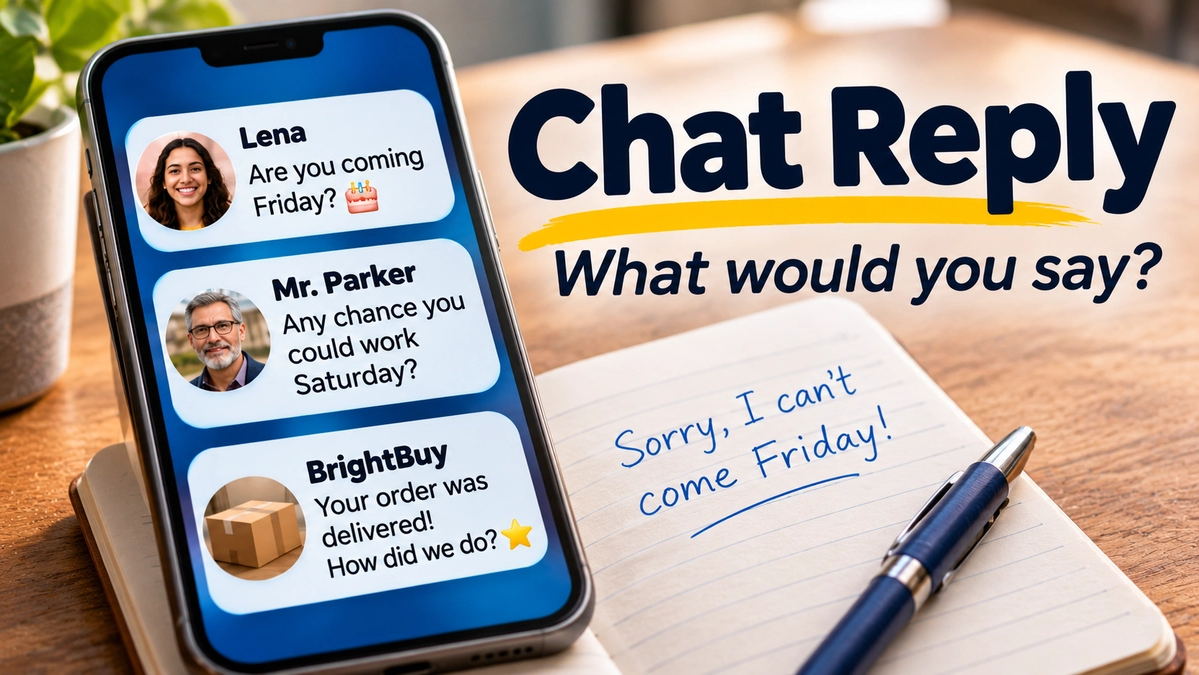
Your friend invites you to a birthday dinner, but you cannot go. What do you say?
Now imagine your manager asks you to work on Saturday. Or a company wants feedback on headphones that arrived broken.
You probably would not reply to all three messages the same way. That is the idea behind Chat Reply, a new writing activity on Cool English where students practice responding to everyday messages from friends, coworkers, teachers, companies, and more.
Eight Messages. Eight Decisions.
Chat Reply comes in two volumes, each with eight conversations: four Easy and four Hard. Both volumes are for subscribers.
The Easy messages cover familiar situations, like making plans with friends, answering a parent, or replying to a classmate. The Hard messages are trickier, such as turning down a request or making a polite complaint.
Students choose a conversation from the inbox and open the chat. They can see who sent the message, what that person said, and what they need to do in their reply. Sometimes the challenge is to say no without hurting someone's feelings. Other times, they need to ask for clarification, suggest an alternative, or respond professionally.
There is no single correct sentence. The challenge is finding a reply that fits the situation.
Write It, Say It, or Type It
Students can write their reply on paper, discuss it with a partner, answer aloud, or type directly into the activity. Easy chats also have a Need help? button with sentence starters.
After students have tried, the teacher reveals a sample response. Students compare their replies with the example and use a short checklist. Did they give a reason? Were they polite? Did they sound friendly enough?
The sample is not the only possible answer. Students can write something completely different and still get it right.
But the Conversation Is Not Over
Some chats do not end after the first reply.
Imagine telling a friend you cannot come to her birthday dinner. She understands, but then asks if you could come later instead.
Now what?
Students get a follow-up message and have to respond again. They cannot just repeat their first answer. It is a small twist that makes the writing feel much more like real messaging.
When "Whatever" Needs Fixing
Some chats start with a problem. A reply has already been sent, and it is a bad one. Sunrise Dental asks to move a cleaning to Thursday at 3 PM, and the answer in the chat is "whatever."
Students write a better reply, then compare it with one: "Hi! Yes, Thursday at 3 PM works for me. Thank you!"
Start Together, Finish at Home
Put one conversation on the screen, give students a minute to think, and ask a few volunteers to share their responses before revealing the example. Then turn it into a discussion. Which reply sounds friendlier? Which one is too direct? Would you write the same thing to a friend and a professor?
Each volume includes a printable worksheet, with space for students to write their answers and an option to include model replies. Try three or four messages together in class, then assign the rest for homework. Students can bring their replies back for comparison and discussion.
Try Chat Reply on Cool English
Ready to try these activities?
Chat Reply
Click below to browse and launch activities with your students
Liked this article?
Get weekly teaching tips and activity guides like this one delivered to your inbox.